

Accused by your own thoughts


A thought can last two seconds. Yet it can set an inner trial in motion: hours spent searching for evidence, interrogating your memory and trying to reach a verdict that removes all doubt.
When a thought becomes a case
I keep coming back to the moment when a thought changes. At first, it is simply something passing through your mind. Then, suddenly, it feels like a question you are responsible for answering. You are no longer just noticing the thought. You begin to interrogate it.
I often think in images, especially when life raises questions with no simple answers. An image cannot settle what a thought means, but it can make something invisible visible.
When I try to understand the mental side of OCD, I picture a courtroom.
The courtroom does not appear because you have done something wrong. It appears when a thought is treated as possible evidence against you: against your morality, your intentions, your love or your identity.
Imagine sitting in this courtroom.
There is no audience, and you cannot see a door. You do not even know exactly what you have done. Yet you are the one in the dock.
On the table in front of you lies the only piece of evidence in the case:
You had a thought.
Perhaps it was violent, sexual or morally disturbing. Perhaps it was about harming someone, losing control, letting someone down or discovering something about yourself that leaves you with unwanted doubts.
The prosecutor stands up:
Why did you have that particular thought? Why did it feel like that? What does it say about you?
The questions sound like reflection. That is what makes answering them so tempting. But a reasonable answer is not enough. It has to remove every trace of doubt.
You begin looking for that answer. At that moment, the trial begins.
It feels as though you can only move on once you have been acquitted.
The thought was brief. The investigation can take hours
We have thoughts all the time. Most pass without our examining whether they reveal something about us.
In OCD, compulsions can be invisible, too. You go over things in your mind, check how you feel, compare, reassure yourself or try to remember with complete accuracy. The courtroom image makes this inner activity easier to see.
A thought may touch on something that matters deeply: your morality, relationships, family or identity. That is precisely why investigating it can feel like the responsible thing to do.
The thought is placed in a mental evidence bag:
- Look at it again.
- Check how you feel again.
- Go over the situation one more time.
- Ask someone whether they think it means something, too.
The theme may change. What matters is not whether your thought resembles anyone else's. It is whether you become caught in analysing, checking or seeking a certainty that never feels certain enough.
From the outside, almost nothing may seem to be happening. Inside, you are working flat out.
An answer can bring short-term relief. That can feel like a sign that the investigation worked. At the same time, the relief can teach the system that the thought really did need investigating. Next time, the case is more readily reopened.
The thought itself may not have been what took up your time. It was everything you felt compelled to do with it.
A self-reinforcing process
When the inner trial keeps going
- Thought
- Alarm
- Investigation
- Short-term relief
- New doubt
New doubt leads back to the thought
Relief can teach the system that the case needs investigating again.
You are the accused, the defence lawyer and the judge
The courtroom image captures something particular about the mental side of OCD: you can be pulled between several of the roles.
As the accused, you fear what the thought might mean and what a verdict would say about you.
As the defence lawyer, you search for the decisive piece of evidence in your favour: I would never do that. I am a good person.
As the judge, you have to decide when the evidence is good enough. But the judge works to an impossible rule: a verdict can only be delivered when no doubt remains.
The inner courtroom
Three roles in the inner courtroom
-
The accused
Fears what the thought might say about you.
-
Defence lawyer
Looks for arguments that prove your innocence.
-
Judge
Demands a verdict that feels completely certain.
The demand: a final verdict before you can move on
It is an impossible demand. Continuing the trial cannot bring certainty.
Every time you find an answer, a new objection follows:
But can you be completely sure? What if you are remembering it wrong? Why does it still feel wrong, then?
More analysis can give you more material. It can rarely deliver the final certainty you were looking for.
The cruellest turn comes when the case is no longer about what you thought, but about who you are.
I had an unpleasant thought becomes:
What if the thought reveals who I really am?
Now you need more than an explanation. You need an acquittal. You want to know for certain that you are a good, loving or harmless person.
That is understandable. When something we value is put on trial, we want to defend it.
But a person cannot be summed up by the most unpleasant thought that passes through their mind. Identity is not just an inner feeling, either. It is lived out over time, in actions, relationships, choices and responsibilities.
It is tempting to answer: I am not my thoughts. I still think it is a beautiful sentence. But if you have to repeat it until you feel completely certain, it has become another argument for the defence.
Perhaps freedom does not mean finding the perfect definition of yourself. Perhaps it means leaving the question unanswered long enough to be present in your own life again.
The harder you defend yourself, the more you treat the accusation as though it deserves a trial.
Breakfast goes cold while the case grows
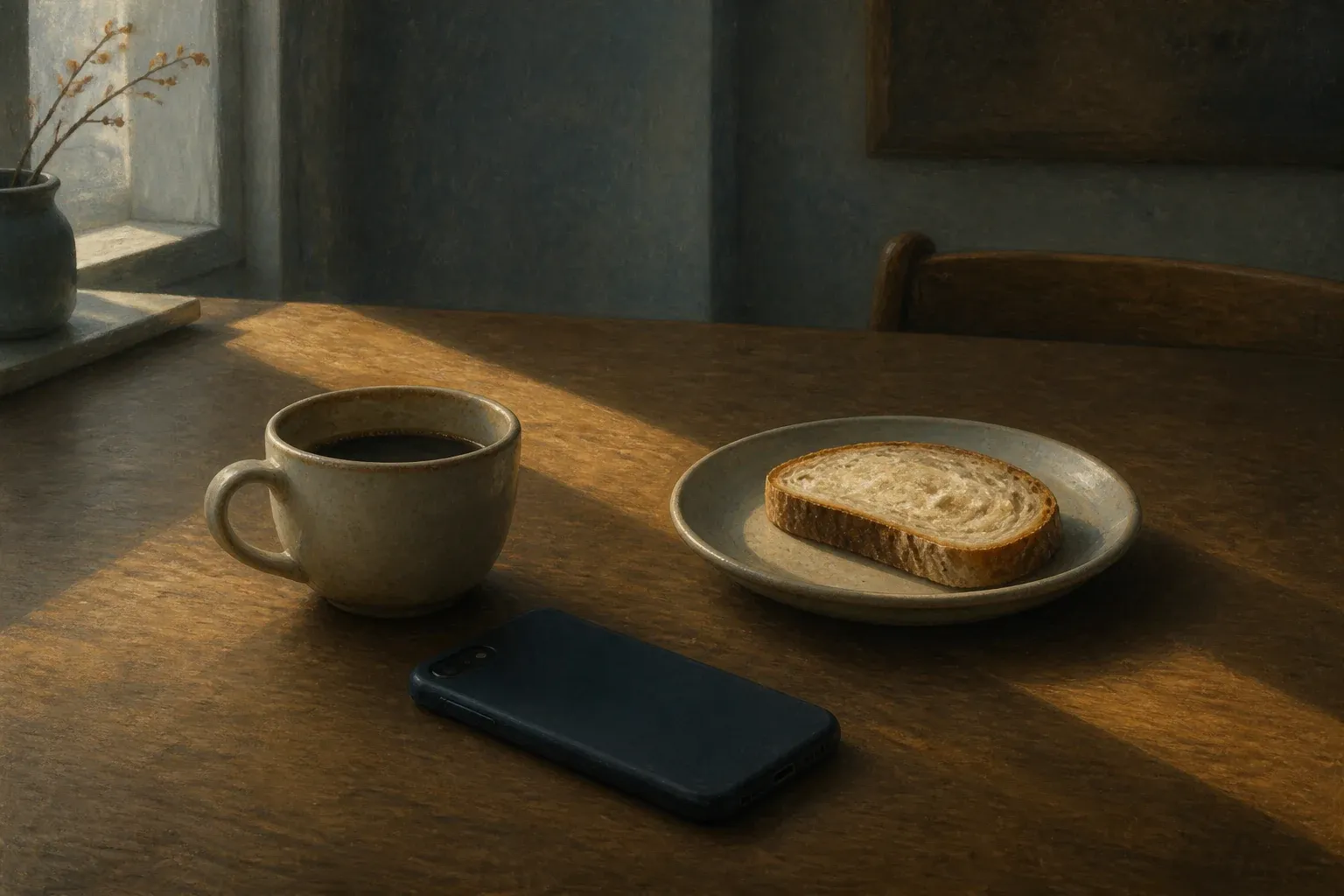
I know these moments. Not always with exactly the same thought, but with the same pattern.
The coffee is on the table. The bread is still untouched, and the phone lies face down. You are about to get on with your morning.
Then a thought arrives about something you said yesterday. Perhaps you sounded cold. What if it wasn't just your tone? What if it says something about you?
First, you go over the conversation to remember it accurately. Then you listen for your own tone of voice. You try to recreate the feeling you had and look for signs that you meant something other than what you said.
You find an explanation that helps. Then a new question arises:
What if that explanation is just something I am telling myself?
The phone is still on the table. The coffee has gone cold. From the outside, almost nothing has happened. But you have been the witness, the investigator, the defence lawyer and the judge in the same case.
The scene could just as easily involve a bodily sensation, a relationship or an intrusive thought. What makes it recognisable is not the content of the thought. It is the return to the same material, again and again, in the hope of finding a certainty that lasts.
You do not need to find the next answer before returning to your morning.
When reflection becomes an inner trial
Ordinary reflection can be thorough and lead to new questions. The difference lies in what you demand of the answer, rather than how many thoughts arise. In the inner trial, the answer has to remove all doubt.
Two ways of approaching a question
Ordinary reflection
Takes in new information
Looks for a practical, reasonable next step
Can end even if it does not feel quite right
Allows you to return to what you were doing
The inner courtroom
Goes over the same material
Demands an answer that removes all doubt
Reopens the question when unease returns
Treats unease or doubt as new evidence
You can recognise the pattern and still find it hard to let go of the investigation.
On the other side of the door
Doubt may follow you out through the door. Perhaps you can still hear the prosecutor's voice as you return to your family, your work or whatever you were doing.
I do not think freedom always feels like certainty.
Sometimes freedom looks far less dramatic:
You take a sip of the coffee that went cold.
You answer someone.
You put on your jacket.
You leave.
Not because the case is closed. Not because you have proved who you are. But because your life is happening somewhere else.
On the other side of the door, you may not find calm. Something more concrete awaits: the chance to take part in the life already unfolding around you.
You do not leave because you have been acquitted.
You leave because you no longer want to take part in the trial.